
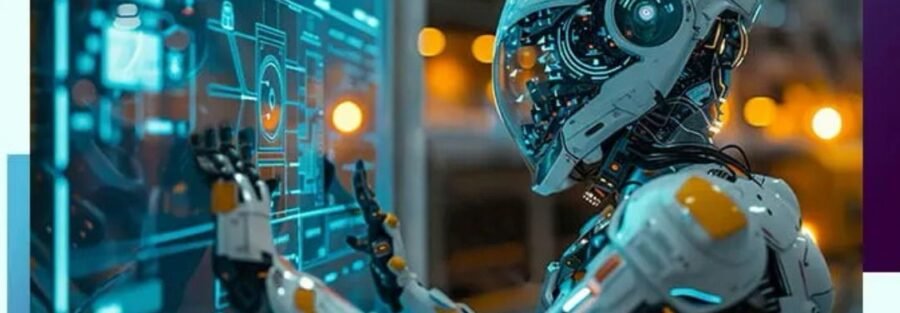
For decades, industries such as manufacturing, logistics, infrastructure, and healthcare defined value creation through traditional productivity metrics—output volume, cost per unit, and optimized labor hours. But today’s rapidly changing environment demands smarter operational models, and AI-driven robotics is emerging as a cornerstone of this shift.
According to Forbes, one of the most underestimated risks in business transformation is overlooking operational safeguards—such as relocating critical systems without adequate protection—which highlights the importance of planning beyond technology when adopting advanced solutions like AI and robotics.
From Rule-Based Automation to Physical Intelligence
Traditional automation delivered efficiency by executing predefined instructions. It worked well in controlled environments but struggled when conditions changed. AI-driven robotics—often referred to as physical AI—moves beyond this limitation. These systems combine machine learning, sensors, and real-time decision-making, allowing them to interpret physical environments, learn from outcomes, and continuously adapt.
McKinsey estimates that AI-powered agents and robots could unlock up to $2.9 trillion in annual economic value in the United States by 2030, provided organizations redesign workflows around intelligent systems and human collaboration rather than simply automating tasks.
This represents a fundamental shift: value is no longer created by accelerating existing processes, but by embedding intelligence into how work is planned, executed, and improved.
Manufacturing: Adaptive Excellence Over Output
In manufacturing, AI-driven robotics is redefining what operational excellence looks like:
- AI-based quality systems detect defects earlier, reducing waste and rework.
- Production lines dynamically adjust to real-time demand signals.
- Condition-based maintenance prevents costly unplanned downtime.
Together, these capabilities move organizations from high-volume production to adaptive, resilient operations. From a consulting perspective, the true value lies not only in higher output but in predictability, flexibility, and the ability to scale without friction—capabilities that traditional productivity metrics fail to capture.
Logistics & Supply Chains: Intelligence as the New Currency
Logistics has historically been optimized around speed and cost. AI-driven robotics reframes this logic:
- Warehouse robots continuously optimize storage and picking paths.
- Routing systems adapt in real time to congestion, weather, or disruptions.
- AI balances inventory across networks to protect service levels.
The result is a supply chain that is not only efficient but also responsive and resilient. Productivity shifts from units moved per hour to continuity of operations under uncertainty—a critical advantage in today’s volatile global environment.
Human–Robot Collaboration: Augmentation, Not Replacement
One of the most common misconceptions about robotics is that it replaces human workers. In reality, the highest-performing organizations design for collaboration, not substitution.
According to Forbes, one of the biggest risks in digital transformation is underestimating the human factor. Technology delivers value only when it is aligned with people, processes, and purpose.
In practice:
- Robots provide precision, endurance, and consistency.
- Humans bring judgment, creativity, and ethical reasoning.
Together, they create a productivity multiplier that surpasses what either could achieve alone.
Rethinking Productivity & Value Measurement
As AI-driven robotics becomes embedded in operations, organizations must rethink how performance is measured. Traditional indicators such as labor hours and output volumes are no longer sufficient.
Leading organizations now track:
- System resilience and recovery time
- Speed and accuracy of operational decisions
- Adaptability to demand and disruption
- Effectiveness of human-machine collaboration
These metrics reflect a shift from short-term efficiency to long-term capability building—the true source of competitive advantage.
Why Strategy Matters More Than Technology
AI-driven robotics does not succeed on technology alone. As Forbes highlights, many transformation initiatives fail when they focus on tools instead of people and purpose.
A strategy-led approach asks:
- Where does intelligence create the most business value?
- What kind of organization are we building?
- How should decision-making evolve with more capable systems?
At Cogniferentials, AI-driven robotics is approached as a strategic enabler—aligned with business objectives, operating models, and leadership priorities, not as an isolated technology project.
Conclusion:
AI-driven robotics is fundamentally reshaping how traditional industries create value. The focus is shifting from doing more with less to doing better with intelligence, adaptability, and strategic intent.
Organizations that recognize this shift early will not only improve efficiency—they will build future-ready capabilities that sustain advantage in a world defined by constant change. In the decade ahead, productivity will no longer be mechanical. It will be intelligent, adaptive, and strategically designed.